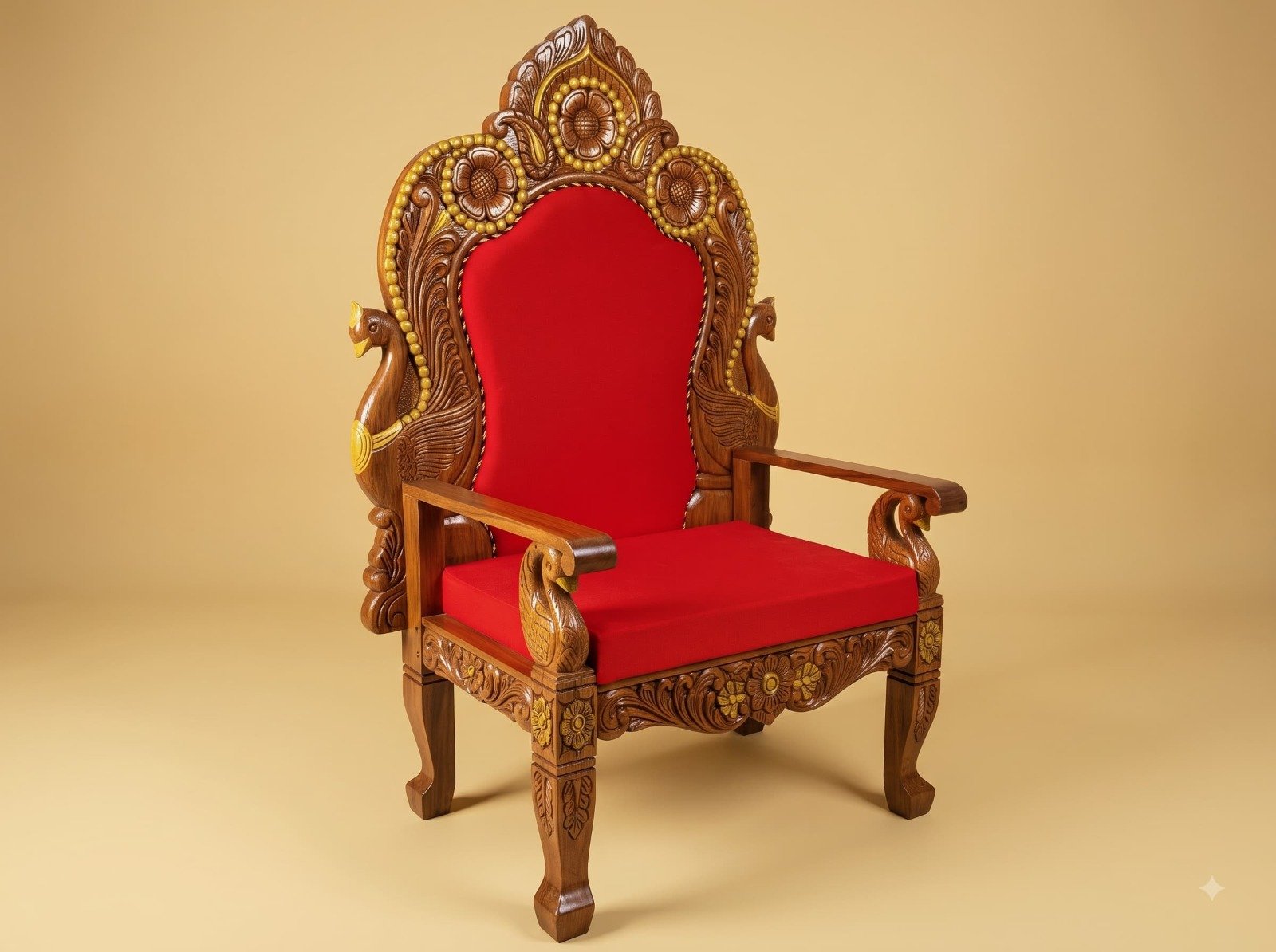
The arms on this chair are straight rails, and they land on a swan's neck. Joining a straight piece of wood to a curved one so that no gap shows is a small job that takes real patience.
A normal tenon shoulder is square - it meets a flat face, and any error shows as a hairline you can close with a shaving. Here the arm rail meets a surface that curves in two directions, and no square shoulder will ever sit against it. Cut the shoulder square and the rail touches at two points with daylight between them, and once the chair is polished that daylight is the first thing anyone sees.
So the shoulder is scribed. The rail is offered up to the finished swan, and a compass is run along the curve with its point on the bird and its pencil on the rail, transferring the exact profile of the curve onto the end of the straight member. The shoulder is then pared back to that line with a chisel, tested, pared again - usually four or five times before it seats without light showing anywhere along it.
It is done twice, once per arm, and neither shoulder can be copied from the other, because no two hand-carved swans curve identically.
 Ask Price On WhatsApp