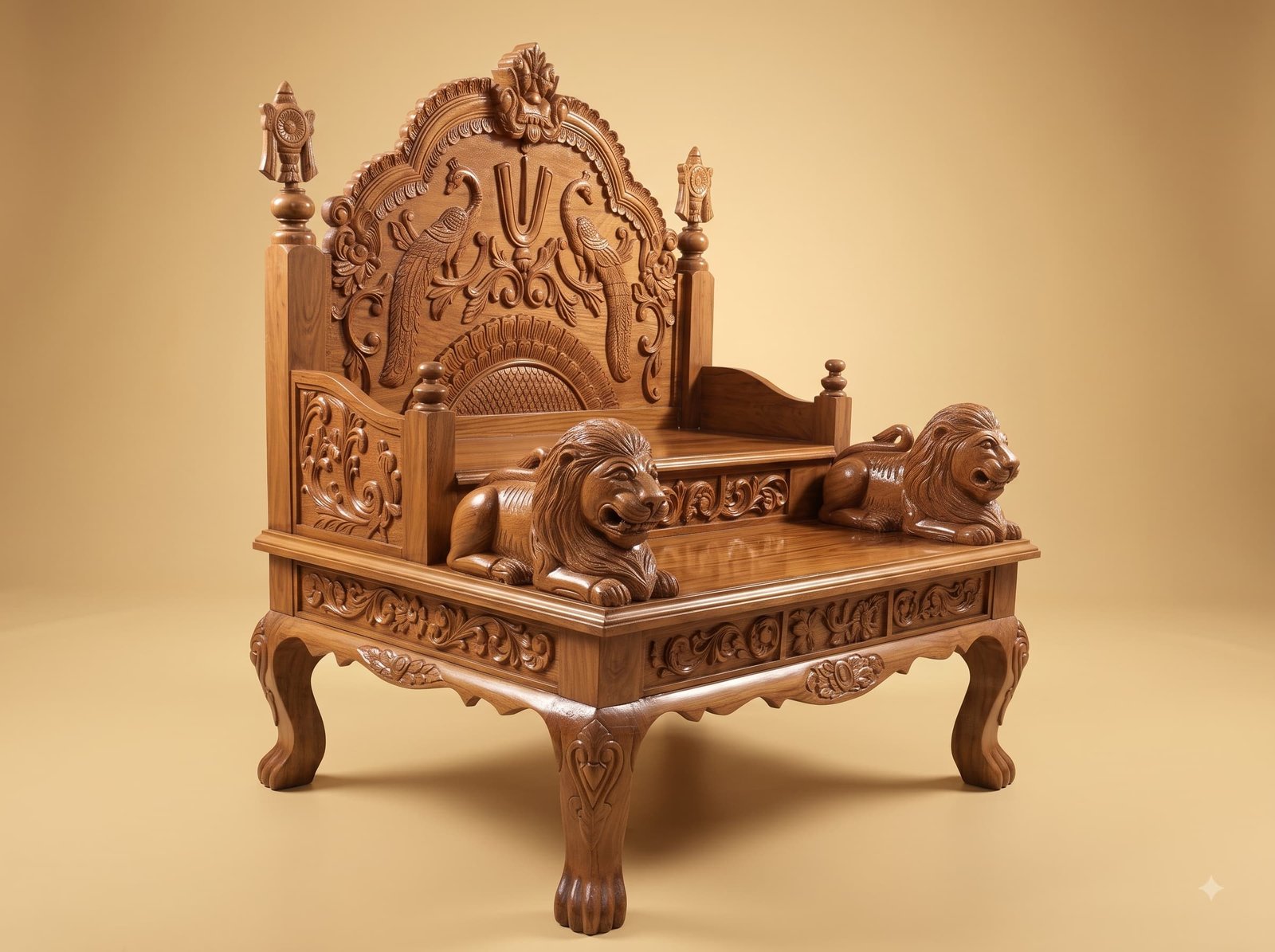
The fluted half-round behind the seat looks like the simplest carving on the whole piece. It is the one that catches people out.
The flutes radiate from a single point at the base, which means they cannot be spaced by measuring along the outer edge. Space them equally by distance and they crowd at the centre and splay at the rim, and the whole fan reads as lopsided even though every gap at the edge is identical. They have to be set out by angle instead - the arc divided into equal degrees from the centre, and each flute marked on that line.
Then the cutting. Every flute is narrow at the centre and wide at the rim, so a single gouge held at one depth would leave a hollow that is deep and dark at the middle and shallow and pale at the outside. The eye reads that as the fan tilting away. So the carver deepens each flute progressively towards the rim, keeping the proportion of depth to width constant along its length.
Do both of those and the fan sits flat and even, throwing the same shadow at every point. Do neither and it looks like a fan of flutes. The difference is entirely in the setting out.
 Ask Price On WhatsApp